These conditions are reshaping individuals, institutions, societies, and the planet.
The ABCD of AI-Issues
and the convergence they create
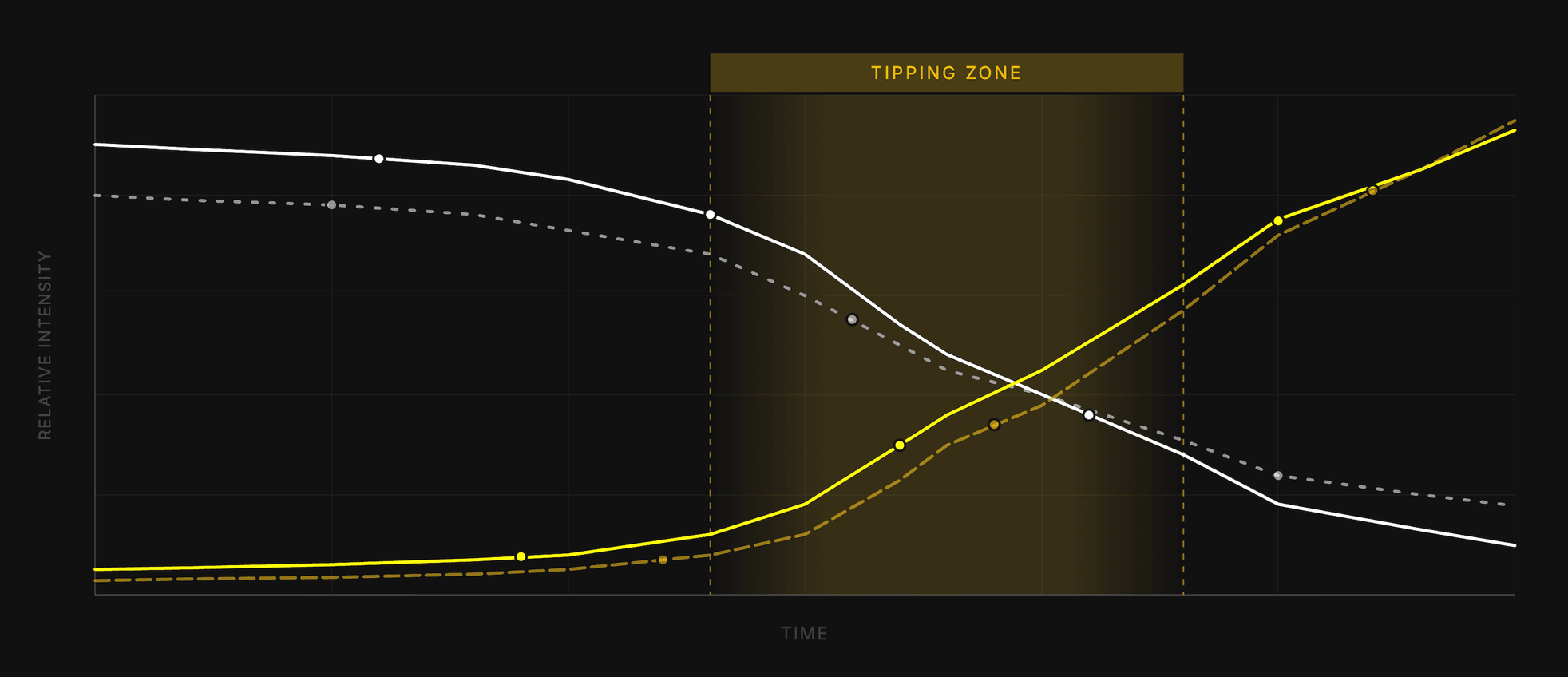
Agency Decay operates at the individual scale. It is the "A" in ABCD: four interconnected arenas through which AI is reshaping human life at every scale, individual, institutional, societal, and planetary. These forces occur simultaneously and are interwoven. Left unaddressed, their convergence defines the Hybrid Tipping Point: the narrow window in which the direction of the hybrid future will be decided.
Agency Decay
IndividualAt the individual level, agency is decaying as algorithms make more decisions for us. The capacity for autonomous judgment does not disappear overnight. It diminishes through disuse, until the moments we most need it, we find it weaker than we knew.
Bond Erosion
SocietyBond Erosion reflects the downside of digitally mediated relationship. AI-curated feeds and chatbot-driven conversations dilute genuine human connection. Instead of dialogue, we encounter algorithmically amplified sensationalism. Authentic emotional experience is replaced by manufactured engagement — and the difference becomes harder to detect with each iteration.
Climate Conundrum
PlanetThe Climate Conundrum is the perverse feedback loop at the heart of the AI age: the more we rely on AI to solve climate change, the more energy we consume, deepening the very problem we aim to solve. Coal plants have delayed closure due to AI energy demand. The ecological cost of machine intelligence is not yet visible in our metrics — but it is accumulating, measurably, in the atmosphere.
Divided Society
InstitutionsDivided Society is an inequality of access and an inequality of burden. 2.6 billion people were completely offline in 2024. They do not benefit from AI. But they pay its costs: data centers drain local water supplies, strain power grids, and divert development funding away from health, education, and climate adaptation. They did not sign up for that progress.
These four arenas do not operate in isolation. They occur simultaneously, they are interwoven, and together they define the narrow window in which the hybrid future will be decided.
Hybrid Tipping Point
Interactive Timeline
From High Human Agency →
To Chronic Dependence
The question becomes which AI, and how.
Not all technology
is the same.
Technology has always shaped human futures. What changes is the speed, the scale, and the intent behind it. AI is the dominant technology of this moment, but it is one stage in something much larger. Quantum AI, robotics, and systems we have not yet named are already forming. The methodology behind ProSocial AI, the 4T framework, the Quadruple Bottom Line, the logic of embedding regenerative intent from the first design decision, is not an AI strategy. It is a prototype for how we approach all technology that comes after. And within AI itself, not all approaches are equal.
Within AI, not all approaches are built to the same standard or toward the same end.
At its core, AI is a form of pattern recognition used to make predictions, generate content, and classify information. It is a neutral technology. Its impact depends entirely on how it is designed, deployed, and governed. It is not inherently good or bad. It is powerful. And power requires direction.
A reactive approach. Ethical AI works to prevent and mitigate harm, using principles, checklists, and compliance measures as guardrails applied after a system is conceived. It focuses on safety and bias reduction. Necessary, but not sufficient: guardrails added after the fact cannot substitute for values built in from the start.
The application of conventional AI to specific social purposes: cancer research, crop monitoring, disaster response. Valuable, but still applying existing AI logic to social ends rather than redesigning the logic itself. The tool is the same. Only the application changes.
A proactive paradigm. ProSocial AI systems are deliberately Tailored, Trained, Tested, and Targeted (the 4Ts) to bring out the best in and for people and planet. The intent to regenerate is built into the architecture from inception. This is not a different use of AI. It is a different kind of AI, built to a fundamentally different standard.
A specific application of ProSocial AI focused on igniting the human aspiration to identify and live up to one’s highest potential. AI4IA is configured to help people flourish: not by optimizing performance, but by activating purpose. At the peak, AI becomes a catalyst for inspired human action.
The kind of AI we build is the kind of world we get.
AI built to bring out the best
in people and planet.
ProSocial AI is a proactive architectural shift. Where conventional AI asks “does this work?” and Ethical AI asks “does this harm?”, ProSocial AI asks: “does this bring out the best in and for people and planet?” Regenerative intent is woven into the algorithmic architecture from the very first decision: through design, training, testing, and deployment. It is not a different use of AI. It is a different kind of AI.
Systems designed for specific socio-cultural, linguistic, and economic contexts, not universal models that encode foreign assumptions onto local realities.
Built for equity. Systems trained on representative, non-biased data to ensure fair outcomes for all, especially those historically excluded from technology’s benefits.
Proven in the real world. Rigorously evaluated for impact on social cohesion, community well-being, and ecological health, not just profit or purely business metrics.
Aimed at the common good. Systems with an explicit, measurable goal of strengthening human agency, social bonds, and planetary sustainability.
When AI is built to the 4T standard, the outcomes are felt at every scale.
For individuals and institutions, the path forward begins with knowing where you stand.
The hybrid future requires
humans who are ready
to lead it.
A world of ProSocial AI is not a passive destination. It requires human agency, which requires Hybrid Intelligence, which is conditioned by Double Literacy. This is the chain of logic that AI4IA is built upon.
Double Literacy is the cognitive and cultural foundation that makes Hybrid Intelligence possible. It integrates two inseparable dimensions. Human Literacy: a holistic understanding of self, society, and ecological systems, including your own aspirations, emotions, thoughts, and sensations. Algorithmic Literacy: a candid comprehension of how AI works, what it misses, how it shapes perception, and where the limits of machine judgment lie. Without both, individuals risk becoming passive consumers of algorithmically curated reality, unable to distinguish their own volition from machine influence. Integrating Double Literacy into education from kindergarten to professional training is the ultimate defense against Agency Decay.
Hybrid Intelligence (HI) arises from the managed complementarity of natural and artificial intelligences, under human leadership. While AI contributes processing power, scale, and pattern recognition, humans provide the context, wisdom, ethical judgment, and emotional depth that algorithms cannot replicate. This collaboration does not emerge automatically. It requires deliberate cultivation. HI is not a future technology. It is a present capacity, waiting to be developed in each person and each institution that chooses to lead rather than follow the AI trajectory.
Double Literacy cultivates Hybrid Intelligence. Hybrid Intelligence sustains Agency Amid AI. And Agency Amid AI is what enables ProSocial futures. A world of AI that brings out the best in and for people and planet requires people who are capable of leading it. We are the last people to remember a world before generative AI. The decisions we make in the next few years will reverberate for generations. The HIQ measures where you stand across all three.
ProSocial AI refers to AI that is tailored, trained, tested, and targeted to bring out the best in and for people and planet. We measure AI today by speed, scale, and cost. Those are not bad questions. They are incomplete ones. When we optimize AI systems solely for technical performance while ignoring their broader social and environmental impacts, we create sophisticated tools that may excel at their narrow tasks while failing spectacularly at serving human flourishing. The ProSocial AI Index provides what is missing: a standardized framework that makes the social, human, and planetary impact of AI visible, comparable, and actionable.
Try one of our assessments to know where you stand.
Hybrid Intelligence
Quotient (HIQ)
Measure your capacity to integrate natural and artificial intelligence in complementarity, across Algorithmic Literacy and Human Literacy: the two entry points for building agency in the hybrid world.
Take the HIQAgency
Assessment
Evaluate your autonomous decision-making in an AI-saturated world. Identify where dependency is replacing your own judgment and locate your position on the agency spectrum.
Take the AssessmentProSocial AI
Index
Score any AI system on how it was built (Tailored, Trained, Tested, Targeted) and who it actually serves (Purpose, People, Prosperity, Planet). The result turns values into evidence and intent into measurable practice.
Assess Your AI SystemsThe work begins within. The outcomes reach beyond.